


On 10 March 2026, the Food Safety and Standards Authority of India (FSSAI) published the Food Safety and Standards (Licensing and Registration of Food Businesses) Amendment Regulations, 2026 in the official Gazette. Effective 1 April 2026, these amendments represent the most sweeping overhaul of India’s food safety licensing framework in over a decade.
Whether you run a fine-dining restaurant in Mumbai, a dhaba on a national highway, a cloud kitchen in Bengaluru, or a street food cart in Delhi, these FSSAI new rules 2026 affect you directly. The headline changes include perpetual (lifetime) license validity, dramatically revised turnover thresholds, automatic registration for street vendors, and a new risk-based inspection system that replaces the old calendar-driven model.
In this comprehensive guide, we break down all 17 major changes, explain what they mean for your restaurant, and give you a practical compliance checklist so you are not caught off guard.
All 17 Major FSSAI Changes at a Glance
Here is a quick before-and-after comparison of every significant change introduced by the FSSAI 2026 amendment. Bookmark this table for easy reference.
| # | Change Area | Before (Old Rule) | After (New Rule from 1 April 2026) |
|---|---|---|---|
| 1 | License Validity | 1 to 5 years; mandatory renewal | Perpetual (lifetime) validity; no renewal required |
| 2 | Registration Validity | 1 to 5 years; mandatory renewal | Perpetual validity; no renewal required |
| 3 | Registration Turnover Limit | Up to ₹12 lakh annual turnover | Up to ₹1.5 crore annual turnover |
| 4 | State License Turnover Range | ₹12 lakh to ₹20 crore | ₹1.5 crore to ₹50 crore |
| 5 | Central License Threshold | Above ₹20 crore | Above ₹50 crore |
| 6 | Street Vendor Registration | Separate FSSAI registration required | Automatic deemed registration under FSSAI if registered under Street Vendors Act 2014 |
| 7 | Inspection Model | Calendar-based, fixed-frequency inspections | Risk-based inspections driven by compliance history, food category risk, and audit results |
| 8 | Third-Party Audits | Voluntary for most FBOs | Mandatory when directed by FSSAI Commissioner or Food Authority; FBO bears cost |
| 9 | Instant Registration | Processing took days to weeks | Instant registration certificate upon document submission |
| 10 | Annual Fee Payment | Fixed annual deadline | Pay for any number of years at once; pay at any time during the year |
| 11 | Food Safety Compliance Return (FSCR) | Annual filing with limited penalties | Strict tiered penalties: 2x fee (up to 90 days late), 5x fee (91-180 days late), deemed suspension after 180 days |
| 12 | License Suspension Trigger | Manual suspension by authority | Automatic deemed suspension if annual fee unpaid or FSCR not filed by deadline |
| 13 | Petty Food Business Definition | Limited categories | Expanded to include food trucks, temporary stalls, cottage/micro food businesses, and individuals distributing food at gatherings |
| 14 | Manufacturing Records | Basic record-keeping | Mandatory daily records of production and raw material utilization for manufacturing FBOs |
| 15 | FoSTaC Training | Required for State/Central license holders | Extended to street food vendors; at least one FoSTaC-certified Food Safety Supervisor per licensed business |
| 16 | Business Closure Protocol | No formal requirement | Must inform licensing authority in writing within 30 days of closure and surrender license |
| 17 | Online/Cloud Kitchen Guidelines | Ambiguous or missing | Clearer compliance guidelines for cloud kitchens and online food sales businesses |
1. Perpetual (Lifetime) FSSAI License: No More Renewals
The single biggest change in the FSSAI license 2026 framework is the shift to perpetual validity. Under the old system, every FSSAI license and registration had a fixed validity of 1 to 5 years. Restaurant owners had to track expiry dates, submit renewal applications months in advance, and risk operating without a valid license if paperwork got delayed.
Starting 1 April 2026, any license or registration issued — regardless of when the application was submitted — will have perpetual validity. This includes applications that were already in the pipeline (document scrutiny, query resolution, or inspection stages) as of the effective date.
What “Perpetual” Actually Means
- Your FSSAI permanent license remains valid indefinitely once granted.
- It can only be terminated through suspension (for non-compliance), cancellation (for serious violations), or voluntary surrender by the operator.
- You still need to pay annual fees and file the Food Safety Compliance Return (FSCR) every year. The license is permanent, but your compliance obligations are not optional.
- Failure to meet compliance obligations triggers automatic (deemed) suspension — more on this below.
What About Existing Licenses?
If your current license was issued before 1 April 2026 and has a fixed expiry date, you will need to follow the transition guidelines issued by FSSAI. The FAQ document released on 27 March 2026 clarifies that existing licenses nearing expiry should be treated under the new perpetual framework upon their next renewal date.
Why This Matters for Restaurants
No more renewal anxiety. No more rushed paperwork. No more risk of operating with an expired license because FSSAI’s portal was down during your renewal window. This change alone saves restaurant owners significant time and reduces administrative burden. However, it shifts the compliance burden to continuous annual obligations rather than periodic renewals.
2. Revised Turnover Thresholds: A Game Changer for Small Restaurants
The second transformative change under the FSSAI new rules 2026 is the dramatic revision of turnover-based categorisation for food business operators (FBOs).
Old vs New Thresholds
| Category | Old Turnover Limit | New Turnover Limit (from 1 April 2026) |
|---|---|---|
| Basic Registration | Up to ₹12 lakh/year | Up to ₹1.5 crore/year |
| State License | ₹12 lakh – ₹20 crore/year | ₹1.5 crore – ₹50 crore/year |
| Central License | Above ₹20 crore/year | Above ₹50 crore/year |
Impact on Restaurant Businesses
This is enormous news for small and mid-sized restaurants. Previously, a restaurant with just ₹15 lakh in annual turnover needed a State License, which involved more paperwork, higher fees, and stricter compliance requirements. Now, that same restaurant falls under the simpler Basic Registration category.
- Small restaurants and dhabas earning up to ₹1.5 crore/year now only need basic registration — a much simpler process.
- Mid-sized restaurant chains earning up to ₹50 crore/year can operate with a State License instead of dealing with Central License requirements.
- This means lower compliance costs, simpler documentation, and faster processing for the vast majority of Indian restaurants.
If your restaurant’s turnover has been creeping above ₹12 lakh and you have been dreading the State License process, this change offers a massive relief. Combined with the cost reduction strategies available through digital ordering tools, your operational overhead just got significantly lighter.
3. Street Vendor Automatic Registration
India has an estimated 10 million+ street food vendors, and until now, most operated without formal FSSAI registration due to the complexity and cost of the application process. The 2026 amendment introduces deemed registration — a landmark change for India’s massive street food ecosystem.
How Deemed Registration Works
- Any street food vendor, hawker, food cart operator, or food truck business already registered under the Street Vendors (Protection of Livelihood and Regulation of Street Vending) Act, 2014 is now automatically deemed registered under the Food Safety and Standards Act, 2006.
- No separate FSSAI application is needed.
- No double fee burden.
- The vendor’s existing Street Vendors Act certificate serves as proof of FSSAI registration.
Expanded Petty Food Business Definition
The amendment also broadens the definition of “Petty Food Business Operator” to explicitly include:
- Small manufacturers and sellers
- Street vendors and hawkers
- Temporary stall holders (melas, exhibitions)
- Food truck operators
- Individuals distributing food at social or religious gatherings (excluding professional caterers)
- Cottage and micro food businesses
This is a welcome move toward formalising India’s unorganised food sector while reducing barriers to entry. For organised restaurants, it means your street food competitors are now also within the regulatory net — creating a more level playing field.
4. Risk-Based Inspection System
Under the old system, FSSAI inspections followed a fixed calendar. A spotless five-star hotel kitchen might get inspected as frequently as a repeatedly non-compliant roadside eatery. The 2026 amendment replaces this one-size-fits-all approach with a risk-based inspection and food safety audit framework.
Factors That Determine Inspection Frequency
- Risk associated with the food category — A restaurant handling raw seafood or dairy will naturally face more scrutiny than a packaged snack retailer.
- Past compliance record — Businesses with a clean track record get fewer inspections.
- Performance in third-party audits — Good audit results reduce inspection frequency.
- Inputs from enforcement and surveillance activities — Consumer complaints and surveillance data feed into the risk assessment.
Third-Party Audits Are Now Mandatory (When Directed)
The amendment makes third-party food safety audits mandatory when directed by the FSSAI Commissioner of Food Safety or the Food Authority. Key points:
- Audits must be conducted by FSSAI-recognised third-party auditing agencies.
- The FBO bears the cost of the audit.
- FBOs must grant access and provide all records to the auditor.
- Audit results feed directly into your risk profile and inspection frequency.
What this means for your restaurant: Maintain excellent food safety practices and your inspections become less frequent. Slip up repeatedly, and expect more scrutiny. It is a system that rewards good behaviour — and punishes complacency harder than before.
5. Stricter Compliance Penalties and Automatic Suspension
The FSSAI permanent license is not a “get it and forget it” deal. The 2026 amendment introduces some of the strictest compliance enforcement mechanisms FSSAI has ever implemented.
Food Safety Compliance Return (FSCR) Penalties
Every licensed FBO must file the annual Food Safety Compliance Return by 31 May each year. Late filing now triggers a tiered penalty system:
| Delay Period | Penalty |
|---|---|
| Up to 90 days late | 2x the annual license fee |
| 91 to 180 days late | 5x the annual license fee |
| Beyond 180 days | Deemed suspension of license |
Automatic (Deemed) Suspension
Under Regulation 2.1.7(2) of the 2026 amendment, your license or registration is automatically deemed suspended if:
- The annual fee is not paid, OR
- The Food Safety Compliance Return is not submitted by the 181st day after the deadline
During suspension, all food business operations must stop immediately. Any activity carried out during suspension is treated as non-compliance and can invite further action under the Food Safety and Standards Act, 2006. Reinstatement is only possible after payment of all dues, penalties, and submission of pending returns.
For a restaurant, even a few days of forced closure can be devastating. This makes timely compliance non-negotiable.
What Restaurants Must Do NOW: Your FSSAI 2026 Compliance Checklist
The regulations are already in effect. Here is your action plan to stay compliant with the FSSAI compliance restaurant requirements:
Immediate Actions (This Week)
- Check your license category: With the new turnover thresholds, you may now fall into a simpler category. If your turnover is under ₹1.5 crore, you may only need basic registration instead of a State License.
- Verify your FSCR filing status: Ensure your annual Food Safety Compliance Return is filed before 31 May 2026 to avoid the new penalty regime.
- Pay your annual fee: Under the new rules, you can pay for multiple years at once. Consider pre-paying to eliminate the risk of automatic suspension due to missed payments.
- Update your FoSTaC certification: Ensure at least one staff member holds a valid FoSTaC Food Safety Supervisor certification.
Short-Term Actions (This Month)
- Audit your record-keeping: Set up systems for maintaining daily production records, raw material utilization logs, and supplier documentation.
- Review allergen information: Ensure your menus clearly list allergen information for each dish, as FSSAI continues to enforce labelling and display regulations.
- Prepare for third-party audits: Organize your kitchen hygiene documentation, staff training records, pest control logs, and food testing reports.
- Set up digital compliance reminders: Mark FSCR deadlines, fee payment dates, and audit schedules in your calendar.
Ongoing Compliance Habits
- Maintain a clean compliance record: Under the risk-based inspection system, a strong compliance history directly reduces your inspection frequency.
- Invest in staff training: Regular food safety training beyond the minimum FoSTaC requirement.
- Keep digital records: Move away from paper-based record-keeping. Digital records are easier to produce during audits and inspections.
- Display your FSSAI license prominently: This remains a mandatory requirement under the Act.
How Digital Tools Help You Stay FSSAI Compliant
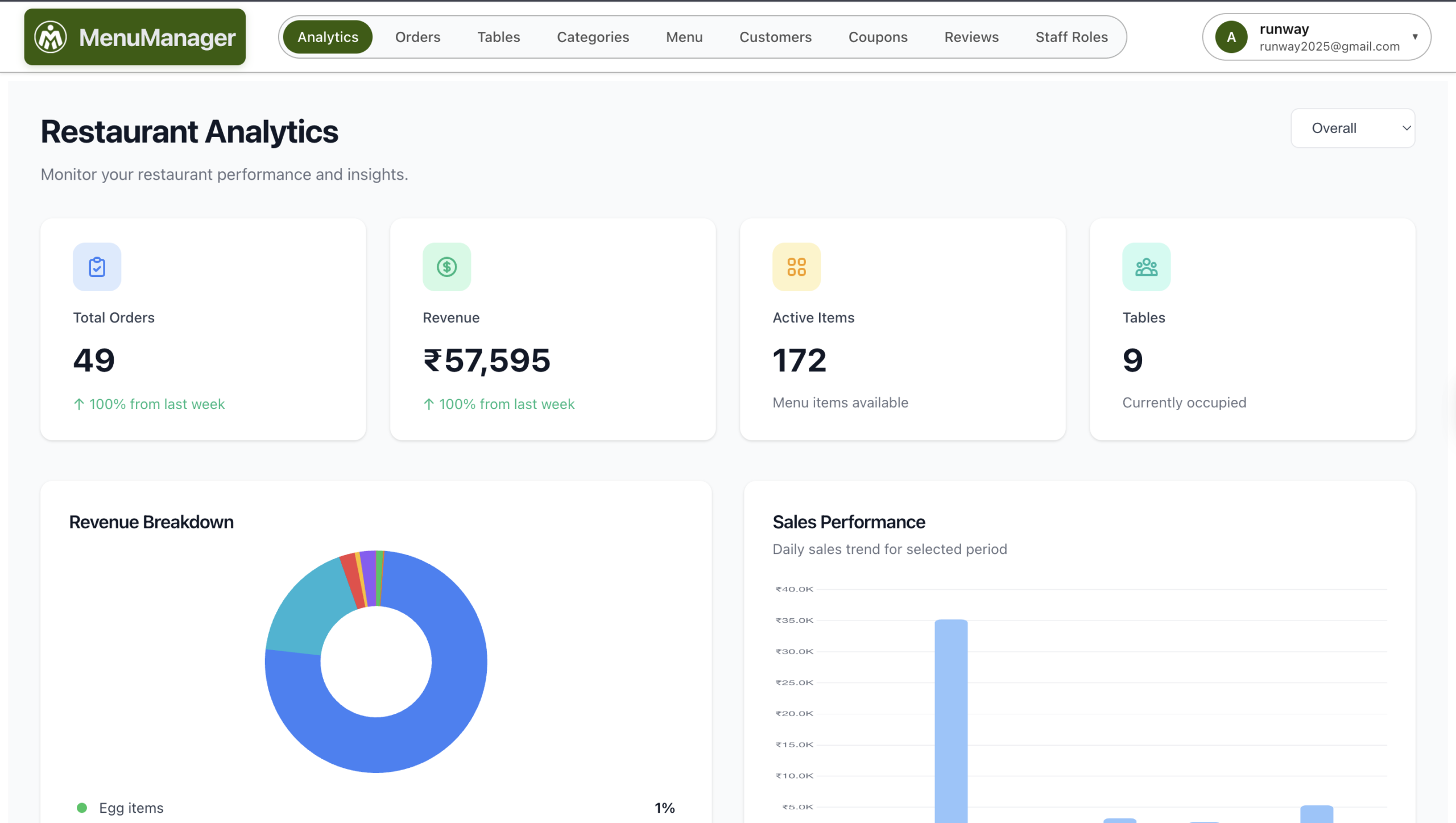
The 2026 amendments make it clear that FSSAI is moving toward a digitised compliance ecosystem. Paper logbooks and handwritten records are increasingly inadequate for meeting the new standards. This is where modern restaurant technology becomes a compliance advantage, not just an operational convenience.
Digital Menus for Allergen Compliance
FSSAI requires restaurants to clearly display allergen information on their menus. With a QR-based digital menu like MenuManager, you can:
- Tag every dish with allergen information (gluten, dairy, nuts, shellfish, etc.)
- Update allergen data instantly when recipes change — no reprinting required
- Display vegetarian/non-vegetarian logos as required by FSSAI
- Provide multilingual allergen information for diverse customers
Order Records for Audit Readiness
Digital ordering systems create automatic, timestamped records of every transaction. During a third-party audit or FSSAI inspection, you can produce:
- Complete order histories with item-level detail
- Daily sales and production data
- Consumption patterns that align with raw material utilization logs
- Revenue data for turnover verification (critical for determining your license category)
Inventory Tracking for Traceability
The new emphasis on daily production records and raw material documentation makes inventory tracking essential. Digital tools help you maintain the traceability chain that FSSAI auditors look for — from supplier to plate.
Adopting a platform like MenuManager is not just about taking orders via QR codes. It is about building a digitally compliant restaurant operation that satisfies the new FSSAI standards while simultaneously reducing your operating costs. With rising input costs — including the recent commercial LPG price hike in May 2026 — every efficiency gain matters.
Explore MenuManager pricing plans to find the right fit for your restaurant’s size and compliance needs.
Frequently Asked Questions: FSSAI New Rules 2026
1. Is the FSSAI license really permanent now? Do I never have to renew?
Yes, licenses and registrations issued on or after 1 April 2026 have perpetual validity. You do not need to renew them. However, you must continue to pay your annual license fee and file the Food Safety Compliance Return (FSCR) every year by 31 May. If you miss these obligations, your license will be automatically (deemed) suspended. So while the license itself is permanent, your compliance responsibilities are annual and non-negotiable.
2. My restaurant earns ₹40 lakh per year. Do I still need a State License?
No. Under the revised turnover thresholds effective 1 April 2026, basic FSSAI registration covers food businesses with annual turnover up to ₹1.5 crore. If your restaurant earns ₹40 lakh per year, you now fall under the basic registration category, which is simpler and less expensive than a State License. If you currently hold a State License, check FSSAI’s transition guidelines for switching to the appropriate category.
3. What happens if I miss the FSCR filing deadline?
The penalties are steep. If you file up to 90 days late, you pay a penalty of 2 times your annual license fee. If you are 91 to 180 days late, the penalty rises to 5 times your annual fee. If you still have not filed by the 181st day, your license is automatically deemed suspended, and you must cease all food business operations immediately until you clear your dues and file the return.
4. How does the risk-based inspection system work for restaurants?
FSSAI will now determine inspection frequency based on four factors: the risk level of the food categories you handle, your past compliance record, your performance in third-party audits, and any enforcement or surveillance inputs (such as consumer complaints). Restaurants with a strong compliance history and good audit results will face fewer inspections. Those with repeated violations or high-risk food handling will be inspected more frequently.
5. I run a cloud kitchen. Do the new rules apply to me?
Absolutely. The 2026 amendment introduces clearer compliance guidelines specifically for cloud kitchens and businesses that sell food online. All the changes — perpetual licensing, revised turnover thresholds, risk-based inspections, FSCR filing requirements, and third-party audit obligations — apply equally to cloud kitchens. In fact, cloud kitchens should pay special attention to record-keeping and traceability requirements, as these are areas where online-only food businesses are increasingly being scrutinised.
The Bottom Line
The FSSAI new rules 2026 represent a fundamental shift in how India regulates its food businesses. The move to perpetual licenses eliminates renewal headaches. The revised turnover thresholds bring relief to lakhs of small restaurants. Automatic street vendor registration brings millions of food businesses into the formal system. And the risk-based inspection model rewards compliance rather than treating every FBO equally.
But with these benefits come stricter consequences for non-compliance. Automatic license suspension, steep penalties for late filings, and mandatory third-party audits mean that restaurant owners cannot afford to be passive about compliance.
The restaurants that will thrive under this new framework are those that embrace digital tools for record-keeping, allergen management, and operational transparency. MenuManager’s QR-based ordering platform helps Indian restaurants stay compliant while reducing costs and improving the dining experience.
Take action today. Review your license category, file your FSCR, and explore how MenuManager can help your restaurant meet the new FSSAI 2026 standards.

Leave a Reply