

LPG prices up. Rent climbing. Minimum wages rising. Ingredient costs swinging wildly every quarter. If you’re running a restaurant in India in 2026, your margins are getting squeezed from every direction. The average restaurant today spends 30-35% of revenue on food, 25-30% on labor, and another 10-15% on rent — before a single rupee of profit. You can’t control the market. But you can control your operations. This guide gives you eight proven, practical ways to cut operating costs without touching the quality your customers expect.
Among the highest-leverage moves restaurants can make is switching to QR code ordering, which cuts staff and printing costs while lifting average order value by 25-35%.
The Real Cost Breakdown of Running a Restaurant in 2026
Most restaurant owners have a rough sense of their costs. But “rough” is exactly the problem. When margins are tight, rough estimates cost you money.
Here’s where the money actually goes in a typical Indian restaurant in 2026:
- Food and beverage cost: 30-35% of revenue. This is your single biggest variable cost — and the most volatile. Ingredient prices shift every season, and inflation has made this category especially unpredictable.
- Labor: 25-30% of revenue. Minimum wage increases across states, higher expectations from trained staff, and the cost of managing attrition all push this number up year over year.
- Rent: 10-15% of revenue. In metros like Mumbai, Delhi, and Bengaluru, prime locations can push this even higher. Many restaurants are quietly relooking their location strategy because of this.
- Energy and LPG: 5-8% of revenue. This was a manageable cost two years ago. In 2026, the ongoing LPG supply disruptions have made this category a serious concern for kitchens that haven’t diversified their energy sources.
- Technology and software: 2-5% of revenue. This category is growing, but unlike the others, it’s the one that actively helps you cut costs everywhere else.
- Overheads (packaging, marketing, miscellaneous): 10-15% of revenue. Often underestimated. Packaging alone has jumped significantly with the rise of delivery orders.
That leaves the average Indian restaurant with a net profit margin of 3-9%. Fine dining can push 15%, but for most QSRs and casual dining restaurants, the range is tight.
Let’s put real numbers on this. Here’s a monthly cost snapshot for a typical 40-seat restaurant in a metro city:
| Cost Category | Monthly Estimate | % of Revenue |
|---|---|---|
| Food & Beverage | ₹1,80,000 – ₹2,10,000 | 30–35% |
| Labor (5-8 staff) | ₹1,50,000 – ₹1,80,000 | 25–30% |
| Rent | ₹60,000 – ₹90,000 | 10–15% |
| LPG & Energy | ₹30,000 – ₹48,000 | 5–8% |
| Technology & Software | ₹5,000 – ₹18,000 | 1–3% |
| Packaging & Marketing | ₹20,000 – ₹40,000 | 3–7% |
| Total Operating Costs | ₹4,45,000 – ₹5,86,000 | 74–98% |
Based on an assumed monthly revenue of ₹6,00,000 for a 40-seat metro restaurant. Actual numbers vary significantly by cuisine type, location, and operating model.
8 Proven Ways to Cut Costs Without Cutting Quality
1. Digitize Your Menu and Ordering
This one sounds obvious but most restaurants still haven’t fully made the shift. Physical menus cost between ₹2,000 and ₹5,000 per month when you factor in design updates, reprinting, lamination, and replacement. That’s before you count the revenue you lose from order errors.
Order errors — wrong items, missed modifications, miscommunication between floor staff and kitchen — cost restaurants an estimated 3-5% of revenue. On ₹6 lakh monthly revenue, that’s ₹18,000-30,000 evaporating every month due to mistakes that are entirely preventable.
Digital menus also let you update prices instantly when ingredient costs change. No reprinting. No outdated menus sitting on tables after your LPG surcharge kicks in. A well-structured digital menu does more than save print costs — it actively drives higher average order values through better item presentation and smart upsells.
2. Reduce Food Waste With Data
Food waste is one of the most under-tracked costs in Indian restaurants. Most owners know roughly which dishes sell well. Very few know the exact numbers — and that gap is expensive.
When you track sales data properly, patterns become obvious. That lamb keema dish you prep 30 portions of every day? You’re consistently selling 18 and throwing away 12. Multiply that waste across your menu and you’ll often find 8-12% of your food cost is going into the bin.
The fix is systematic. Reducing food waste in your restaurant starts with tracking daily sales per item, then right-sizing your prep quantities. Combine that with menu engineering — cutting the low-sellers that also require expensive or perishable ingredients — and you can meaningfully reduce your food cost percentage within 60 days.
3. Optimize Staff Scheduling
Most restaurants run on gut instinct when it comes to scheduling. “Friday’s busy, put everyone on.” But the actual peak hours within Friday? The difference between 7pm and 9pm footfall? Most owners couldn’t tell you with precision.
When you have order data by hour and day, you can schedule staff around actual demand. If your kitchen gets 60% of orders between 12:30pm and 2pm and 7pm and 9:30pm, you don’t need full staff coverage at 4pm. Two to three hours of adjusted scheduling per staff member per week adds up fast.
Additionally, smart table management systems with QR-based ordering directly reduce your dependency on order-taking staff. One staff member handling QR-order tables can manage more tables than one taking orders manually — without the service quality dropping.
4. Negotiate Vendor Contracts Quarterly
Most restaurant owners negotiate vendor rates once and then auto-renew silently for years. Meanwhile, commodity prices shift every season, new suppliers enter the market, and your current vendor’s rates quietly drift upward.
Build a habit of reviewing your top five vendors every quarter. Get at least one competing quote. You don’t need to switch — often just showing a competitor’s rate is enough to bring your existing supplier back down. On a food cost of ₹1.8 lakh per month, a 5% reduction in procurement costs saves ₹9,000 per month — ₹1.08 lakh per year.
For seasonal items, consider locking in forward contracts during off-season when prices are lower. It requires a bit more planning but can significantly smooth out the cost spikes that hit during peak demand months.
5. Switch to Energy-Efficient Equipment
Older kitchen equipment — gas burners, commercial refrigerators, exhaust systems — runs significantly less efficiently than modern alternatives. Induction cooking systems, for example, are 40-70% more energy efficient than traditional gas burners for certain preparation tasks.
The upfront cost is real. A commercial induction unit costs ₹15,000-40,000. But with LPG costs spiking and supply becoming unreliable in 2026, the case for reducing LPG dependency has never been stronger. Pair that with LED kitchen lighting and Energy Star rated refrigeration, and most restaurants see full ROI within 6-12 months.
Start with your highest-usage equipment. The equipment running 8-10 hours a day is where efficiency gains matter most. A single commercial refrigerator upgrade can save ₹2,000-4,000 per month in electricity costs alone.
6. Use a Direct Ordering System
This is one of the most significant financial decisions a restaurant can make in 2026. Third-party delivery platforms charge commissions of 15-30% per order. On a ₹500 order, you’re paying ₹75-150 to the platform before your food, labor, and rent costs even enter the picture.
Many restaurants have built their delivery revenue entirely on third-party platforms without realizing how much margin they’re surrendering. A restaurant doing ₹1.5 lakh per month in delivery revenue through a 25% commission platform is paying ₹37,500 every month — ₹4.5 lakh per year — in platform fees.
A QR-based direct ordering system lets customers order and pay without going through a third-party intermediary. You capture 100% of that revenue. You also own the customer relationship — which matters enormously for retention and repeat business.
7. Run Data-Driven Promotions
Blanket discounts are expensive. “20% off everything” is a cost center masquerading as a marketing strategy. It attracts deal-seekers who don’t return at full price, and it trains your existing customers to wait for discounts before ordering.
Smarter promotions use minimum order amounts, target specific slow hours, or bundle high-margin items with lower-margin ones. A “free dessert on orders above ₹800” promotion, for instance, costs you the direct cost of that dessert (often ₹60-80) but can increase average check size by ₹150-200.
The key is tracking the ROI of every promotion. How many incremental orders did it generate? What was the average check value? Did those customers return without a promotion? Data-driven revenue strategies replace gut instinct with numbers — and the results are consistently better.
8. Track Expenses Religiously
This is the foundational habit that makes all the others work. Most restaurant owners have a general sense of costs. Very few track them with the granularity needed to actually catch leaks.
What does “tracking expenses religiously” actually mean? Daily reconciliation of food usage versus sales. Weekly labor cost review by shift. Monthly vendor invoice audits. Quarterly comparison of cost percentages versus your targets.
When you do this consistently, you catch things. The LPG cylinder count that doesn’t match kitchen usage. The portion sizes that have crept up without a price adjustment. The vendor who quietly increased rates on three SKUs. None of these are dramatic — but they compound. Untracked costs in a typical restaurant add up to 5-8% of revenue in preventable leakage.
Technology That Pays for Itself
Restaurant technology in India has crossed an important threshold in 2026: the cost of good software is now low enough that the question isn’t whether you can afford it — it’s whether you can afford to operate without it.
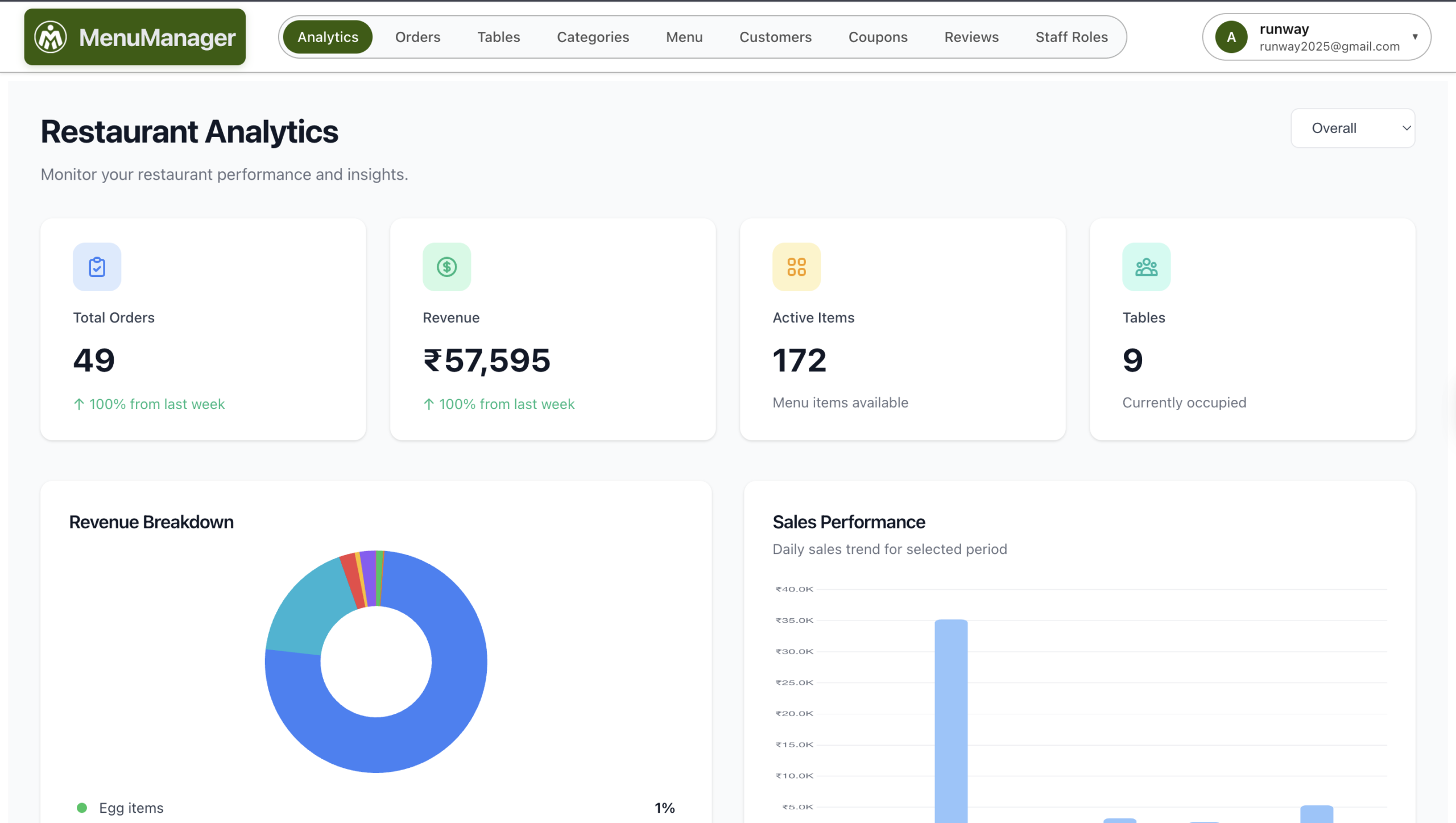
A full-featured restaurant management platform costs roughly ₹999-1,500 per month at the entry level. That’s your digital menu, QR ordering, table management, and basic analytics in one system. What does that buy you?
- Elimination of paper menu printing: saves ₹2,000-5,000/month
- Reduction in order errors: saves 3-5% of revenue
- Faster table turns: industry data shows digital orders increase check averages by approximately 30% compared to traditional ordering
- Staff efficiency: QR ordering means fewer staff needed for order-taking during peak hours
- Direct ordering capability: eliminates third-party commissions on delivery orders you own
This isn’t specific to any one tool. Whether you use MenuManager, Petpooja, Posist, or another platform, the category itself has proven ROI. Tools like MenuManager are worth evaluating alongside others — the right fit depends on your restaurant’s specific setup and scale.
The broader industry trend is clear: restaurants that invested in digital infrastructure between 2022-2024 consistently outperformed those that didn’t, on both revenue growth and margin retention. In 2026, that gap is wider.
What Smart Restaurant Owners Are Doing Differently in 2026
The operators who are genuinely thriving in 2026’s margin environment aren’t doing one big thing differently. They’re doing many small things consistently. A few patterns stand out.
Hybrid dine-in and delivery models are cutting costs 10-15%. By designing their menu and kitchen workflow to serve both channels efficiently — rather than treating delivery as an afterthought — smart operators are spreading their fixed costs across higher revenue without proportionally increasing variable costs.
Direct ordering is replacing third-party dependency. The most financially savvy restaurants are using aggregators for discovery — to reach new customers — but actively migrating repeat customers to direct ordering channels. Over 12 months, this shift can move 40-60% of delivery revenue from commission-heavy platforms to commission-free direct channels.
AI-driven inventory management is reducing waste by up to 40%. Larger restaurant chains adopted this technology first, but the tools have come down in price and complexity enough that mid-size standalone restaurants are now using AI-assisted ordering recommendations based on historical sales data, weather patterns, and local event calendars.
Crisis menu engineering is becoming standard practice. Rather than freezing menus when ingredient or energy costs spike, proactive operators are maintaining a “crisis menu” protocol — a pre-designed set of menu adjustments they can activate within 48 hours when costs shift. This includes energy-efficient cooking alternatives and ingredient substitution maps for volatile items.
The shift from reactive to proactive cost management is the defining difference. Reactive operators raise prices or cut portions when margins get tight. Proactive operators have set cost percentage targets, track them weekly, and make small adjustments continuously rather than large painful ones periodically.
The Bottom Line
There’s no single hack that fixes a restaurant’s cost structure. But there is a reliable path: identify your three biggest cost centers, track them precisely, and make consistent improvements.
For most Indian restaurants in 2026, those three cost centers are food, labor, and energy. Reduce food waste by even 5%, optimize staff scheduling to cut 2-3 unnecessary shift hours per week, and reduce energy costs by switching key equipment — and you’re looking at a combined improvement that could add 3-5 percentage points to your net margin.
On a restaurant doing ₹6 lakh per month, that’s ₹18,000-30,000 of additional monthly profit. ₹2.16-3.6 lakh per year. From operational discipline alone, without adding a single new customer.
Technology is an investment, not an expense. The restaurants treating digital tools as costs to be minimized are losing ground to those treating them as margin-protection infrastructure.
Start with the biggest leaks. Fix them systematically. Then move to the next. Small, consistent changes compound into major savings over 12-24 months — and unlike one-time cost cuts, operational improvements keep paying dividends every month.
If you’re looking for a starting point, explore MenuManager’s pricing to see what a digital menu and direct ordering system costs versus what it saves in your specific context.
Frequently Asked Questions
What are the biggest operating costs for restaurants in India?
The three biggest operating costs for Indian restaurants are food and beverage (30-35% of revenue), labor (25-30%), and rent (10-15%). Together, these three categories typically account for 65-80% of total operating costs. Energy costs, which were historically 5-8%, have become more significant in 2026 due to LPG supply volatility.
How much can a digital menu save per month?
A digital menu saves a restaurant approximately ₹2,000-5,000 per month in printing costs alone. Beyond direct savings, reducing order errors (which cost 3-5% of revenue) and increasing average check size through better item presentation typically add another ₹5,000-20,000 per month in recovered revenue, depending on restaurant size and order volume.
Is restaurant management software worth the cost for small restaurants?
Yes, for most restaurants with monthly revenue above ₹2-3 lakh. Entry-level restaurant management software costs ₹999-1,500 per month and typically saves multiples of that in reduced printing costs, fewer errors, and faster service. The direct ordering feature alone — which eliminates third-party delivery commissions of 15-30% — can save far more than the software cost within the first month for restaurants with any delivery volume.
How do I calculate my restaurant’s food cost percentage?
Food cost percentage = (Cost of Goods Sold / Total Food Revenue) × 100. To calculate Cost of Goods Sold: Opening inventory + Purchases − Closing inventory = COGS. For example, if you start the month with ₹50,000 in stock, purchase ₹1,80,000, and end with ₹40,000, your COGS is ₹1,90,000. If your food revenue was ₹5,50,000, your food cost percentage is 34.5%. Track this weekly, not just monthly, to catch upward trends early.
What’s the average profit margin for Indian restaurants?
The average net profit margin for Indian restaurants ranges from 3-9% for casual dining and QSR formats. Fine dining establishments can achieve 10-15% with higher price points. Cloud kitchens and delivery-focused formats tend to operate at 8-12% margins due to lower rent costs. These figures are before owner salary — many small restaurant owners mix personal income with business profit, which can make margins appear higher or lower than they actually are.
How can I reduce staff costs without firing employees?
The most effective approaches are scheduling optimization, cross-training, and reducing manual tasks through technology. Scheduling staff based on actual peak-hour data — rather than keeping full coverage all day — can reduce total weekly labor hours by 10-15% without reducing service quality. Cross-training staff to handle multiple roles (order-taking, billing, light kitchen prep) reduces the number of specialized staff needed. QR ordering systems reduce the number of staff needed for order-taking specifically, allowing the same team to serve more tables.
{ “@context”: “https://schema.org”, “@type”: “FAQPage”, “mainEntity”: [ { “@type”: “Question”, “name”: “What are the biggest operating costs for restaurants in India?”, “acceptedAnswer”: { “@type”: “Answer”, “text”: “The three biggest operating costs for Indian restaurants are food and beverage (30-35% of revenue), labor (25-30%), and rent (10-15%). Together, these three categories typically account for 65-80% of total operating costs. Energy costs, which were historically 5-8%, have become more significant in 2026 due to LPG supply volatility.” } }, { “@type”: “Question”, “name”: “How much can a digital menu save per month?”, “acceptedAnswer”: { “@type”: “Answer”, “text”: “A digital menu saves a restaurant approximately ₹2,000-5,000 per month in printing costs alone. Beyond direct savings, reducing order errors (which cost 3-5% of revenue) and increasing average check size through better item presentation typically add another ₹5,000-20,000 per month in recovered revenue, depending on restaurant size and order volume.” } }, { “@type”: “Question”, “name”: “Is restaurant management software worth the cost for small restaurants?”, “acceptedAnswer”: { “@type”: “Answer”, “text”: “Yes, for most restaurants with monthly revenue above ₹2-3 lakh. Entry-level restaurant management software costs ₹999-1,500 per month and typically saves multiples of that in reduced printing costs, fewer errors, and faster service. The direct ordering feature alone — which eliminates third-party delivery commissions of 15-30% — can save far more than the software cost within the first month for restaurants with any delivery volume.” } }, { “@type”: “Question”, “name”: “How do I calculate my restaurant’s food cost percentage?”, “acceptedAnswer”: { “@type”: “Answer”, “text”: “Food cost percentage = (Cost of Goods Sold / Total Food Revenue) × 100. To calculate Cost of Goods Sold: Opening inventory + Purchases − Closing inventory = COGS. For example, if you start the month with ₹50,000 in stock, purchase ₹1,80,000, and end with ₹40,000, your COGS is ₹1,90,000. If your food revenue was ₹5,50,000, your food cost percentage is 34.5%. Track this weekly, not just monthly, to catch upward trends early.” } }, { “@type”: “Question”, “name”: “What’s the average profit margin for Indian restaurants?”, “acceptedAnswer”: { “@type”: “Answer”, “text”: “The average net profit margin for Indian restaurants ranges from 3-9% for casual dining and QSR formats. Fine dining establishments can achieve 10-15% with higher price points. Cloud kitchens and delivery-focused formats tend to operate at 8-12% margins due to lower rent costs.” } }, { “@type”: “Question”, “name”: “How can I reduce staff costs without firing employees?”, “acceptedAnswer”: { “@type”: “Answer”, “text”: “The most effective approaches are scheduling optimization, cross-training, and reducing manual tasks through technology. Scheduling staff based on actual peak-hour data can reduce total weekly labor hours by 10-15% without reducing service quality. QR ordering systems reduce the number of staff needed for order-taking specifically, allowing the same team to serve more tables.” } } ] }
Leave a Reply