

After a full decade away, Restaurant Week India is back — and it is bigger, sharper, and more curated than ever. Running from April 24 to May 3, 2026, this edition brings together over 55 handpicked restaurants across Mumbai, Delhi-NCR, and Bengaluru for 10 days of prix-fixe dining that puts India’s best kitchens in the spotlight.
Whether you are already on the 2026 roster or planning to apply for the next edition, this guide will help you understand how Restaurant Week works, prepare your restaurant operations, engineer a profitable fixed-price menu, and — most importantly — convert first-time diners into lifelong regulars.
What Is Restaurant Week India and Why Should You Care?
Restaurant Week is a global dining concept that originated in New York City in 1992. The idea is simple: participating restaurants offer specially designed three-course prix-fixe menus at fixed price points, giving diners access to fine-dining and premium-casual experiences at approachable rates.
In India, the concept was first introduced in 2010 as Citibank Restaurant Week India. It ran successfully for several years — growing from 7 restaurants in Mumbai to over 70 restaurants across three cities by 2013 — before going on hiatus. The 2026 edition marks a triumphant return after more than 10 years, reimagined for a new generation of Indian diners.
For restaurant owners, Restaurant Week is not just a promotional event. It is a customer acquisition engine. Diners who would never have walked through your door at full price are now prepaying for a seat. Your job is to deliver an experience so memorable that they come back at regular prices — and bring friends.
Restaurant Week India 2026: Dates, Cities, and Pricing
Here is everything you need to know about the 2026 edition at a glance:
| Detail | Information |
|---|---|
| Event Name | Restaurant Week India 2026 (Summer Edition) |
| Dates | April 24 – May 3, 2026 (10 days) |
| Cities | Mumbai, Delhi-NCR, Bengaluru |
| Participating Restaurants | 55+ curated restaurants |
| Lunch Price | ₹1,500++ per person (three courses) |
| Dinner Price | ₹1,800++ per person (three courses) |
| Bookings Open | April 17, 2026 |
| Booking Platform | Official RWI platform (via Putting Scene) |
| Beverages | Excluded from base price, billed separately |
| Walk-ins | Not accepted — prepaid reservations only |
Notable Participating Restaurants
| City | Featured Restaurants |
|---|---|
| Mumbai | The Bombay Canteen, The Table, Americano, Bar Paradox, La Loca Maria, Sobo20, Toast Pasta Bar, Hearth, Izumi |
| Delhi-NCR | Adrift Kaya, Ikk Punjab, Inja, Nisaba, Bhawan |
| Bengaluru | Bar Sama, Comal, Kopitiam Lah, Tijouri, Lupa, The Hood |
How Restaurant Week India Works
Understanding the mechanics of Restaurant Week is critical for maximizing your returns. Here is the step-by-step flow:
For Restaurants
- Application and Selection: Restaurants apply through the Restaurant Week India organizers. The 2026 edition is tightly curated, so selection is competitive. Focus on what makes your restaurant unique.
- Menu Design: You create a special three-course prix-fixe menu (starter, main, dessert) exclusively for the event. Multiple options within each course allow diners to customize within the fixed framework.
- Pricing Agreement: All restaurants agree to the standardized pricing — ₹1,500++ for lunch and ₹1,800++ for dinner. Beverages are billed separately, which is an important upsell opportunity.
- Prepaid Reservations: Diners book and pay in advance through the centralized platform. This means guaranteed covers and zero no-show risk.
- Execution: During the 10-day window, you serve the curated menus alongside your regular offerings. Most restaurants run Restaurant Week as a separate seating or section.
For Diners
- Browse participating restaurants on the official platform
- Select a restaurant, date, meal (lunch or dinner), and number of guests
- Prepay for the prix-fixe menu
- Show up, enjoy the curated three-course experience
- Pay separately for beverages and any add-ons
10 Tips to Maximize Revenue During Restaurant Week India 2026
Restaurant Week is not about discounting — it is about strategic customer acquisition. Here are 10 actionable tips to ensure you come out profitable and with a stronger customer base.
1. Engineer Your Menu for Margin, Not Just Appeal
Your prix-fixe menu should feature dishes that are high on perceived value but low on food cost. Use the classic menu engineering matrix: prioritize your “Stars” (high popularity, high profit) and “Puzzles” (high profit, low popularity — this is their moment to shine). Avoid including your most expensive-to-produce dishes.
At ₹1,500-1,800 per cover, your target food cost should stay below 30-32% to maintain profitability even at the fixed price point.
2. Create a Beverage Upsell Strategy
Since beverages are excluded from the prix-fixe price and billed separately, this is your biggest revenue lever. Design curated beverage pairings — a cocktail flight, wine pairing, or mocktail set menu — that complement each course. A well-designed pairing menu can add ₹800-1,500 per cover to your average ticket size.
3. Optimize Table Turnover Without Rushing Guests
With prepaid reservations and fixed menus, you have the advantage of predictability. Stagger your reservation slots to allow for 75-90 minute seatings during lunch and 90-120 minutes for dinner. This lets you run two full turns during each service without compromising the dining experience.
4. Pre-Prep Like Your Business Depends on It
A fixed menu is a gift to your kitchen. You know exactly what diners will order, which means you can batch-prep sauces, marinate proteins, pre-portion desserts, and mise en place every component. This slashes ticket times and labor costs while maintaining consistency across 10 high-volume days.
5. Train Your Staff to Sell, Not Just Serve
Brief your front-of-house team on every dish in the prix-fixe menu — ingredients, preparation methods, and the story behind each plate. When servers can passionately describe the food, diners order more beverages, add-ons, and extras. Also train them to subtly mention your regular menu and upcoming events to encourage repeat visits.
6. Offer Exclusive Add-Ons and Upgrades
Create a short list of premium add-ons: an amuse-bouche, a cheese course, a premium dessert upgrade, or a signature cocktail. These ₹200-500 add-ons feel like small indulgences to diners but add up significantly across hundreds of covers over 10 days.
7. Use the Event for Social Proof
Being selected for Restaurant Week India is a badge of honor. Use it in your marketing aggressively. Update your Google Business Profile, Instagram bio, and website with the Restaurant Week badge. Share behind-the-scenes content of your chef designing the menu. The social proof from being “Restaurant Week-selected” lasts long after the event ends.
8. Capture Every Customer’s Contact Information
This is perhaps the most overlooked opportunity. Restaurant Week brings dozens of new diners through your doors — diners who have already demonstrated willingness to spend on dining experiences. If you don’t capture their phone number or email, you have paid the cost of acquisition with nothing to show for it long-term.
A QR-based ordering system like MenuManager captures customer data automatically when diners scan, browse, or order. No awkward “Can I get your email?” conversations — the data flows into your CRM as a natural part of the dining experience.
9. Plan Your Post-Event Follow-Up Before the Event Starts
Have your WhatsApp and email follow-up sequences ready before Restaurant Week begins. Within 48 hours of their visit, send a personalized thank-you message. Within a week, share a “Welcome Back” offer — perhaps 15% off their next visit or a complimentary appetizer. The window to convert a one-time diner into a regular is narrow, so act fast.
10. Collect and Showcase Reviews Immediately
Happy diners are at peak willingness to leave a review immediately after a great meal. Place a QR code on the table that links directly to your Google review page. You can also use a QR menu system that prompts for feedback after payment. A surge of 50-100 positive reviews during Restaurant Week can dramatically boost your local SEO rankings for months.
Menu Engineering for Restaurant Week: Build a Profitable Prix-Fixe Menu
The fixed-price format is both a constraint and an opportunity. Here is a framework for building a menu that delights diners while protecting your bottom line.
The Menu Engineering Matrix
Categorize every dish in your current menu based on two dimensions — popularity and profitability:
| Category | Popularity | Profit Margin | Restaurant Week Strategy |
|---|---|---|---|
| Stars | High | High | Feature prominently — these are your headliners |
| Plowhorses | High | Low | Avoid — popular but they will eat your margin at fixed prices |
| Puzzles | Low | High | Include as options — fixed pricing removes the price barrier that held them back |
| Dogs | Low | Low | Exclude entirely |
Use Data to Drive Menu Decisions
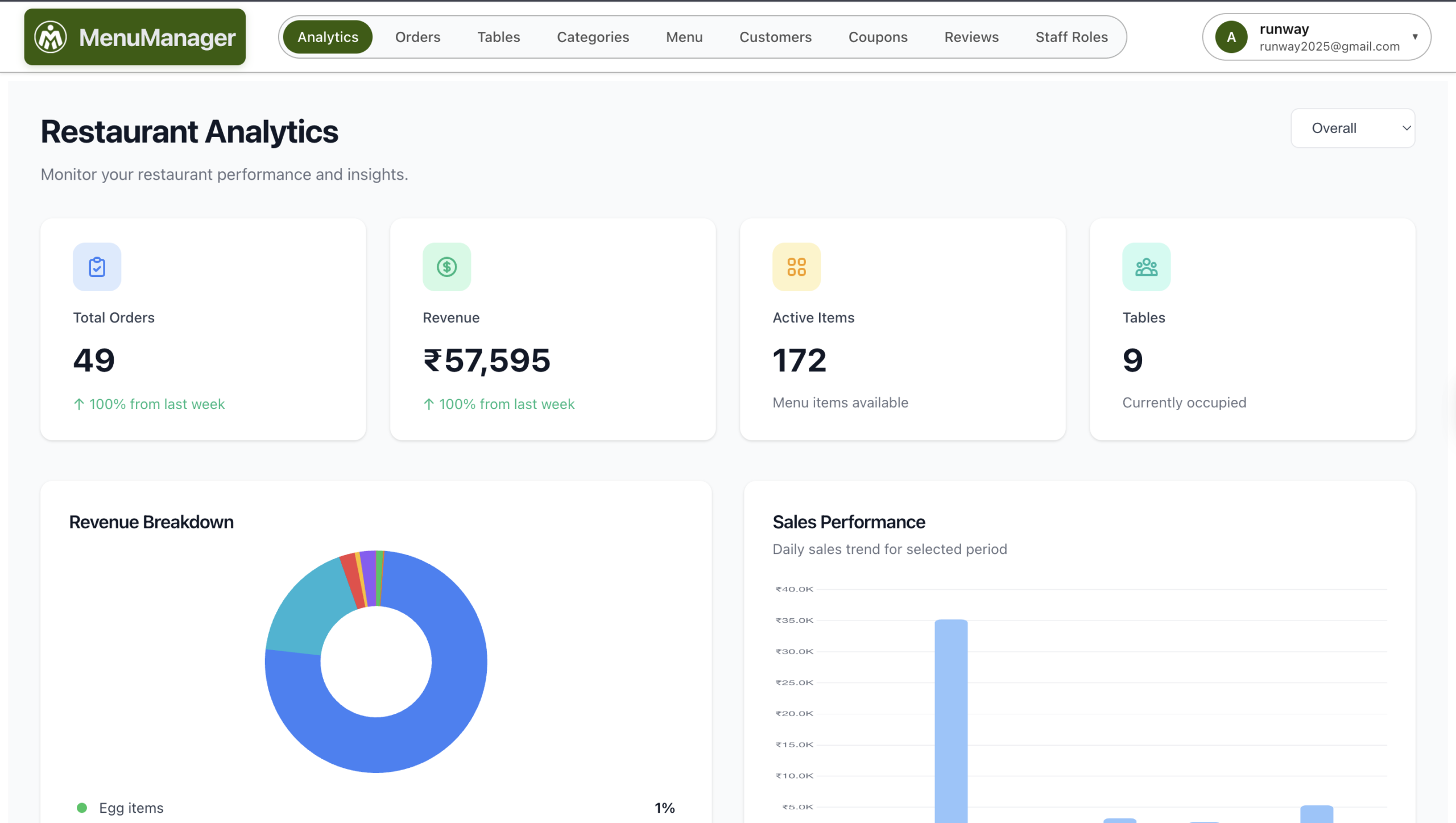
If you have been running a digital menu or QR ordering system, you already have a goldmine of data. Tools like MenuManager track which dishes are viewed most, which are ordered most, and which have the highest completion rates. Use this data to identify your Stars and Puzzles before designing your Restaurant Week menu.
For example, if your analytics show that your truffle mushroom risotto has a high view-to-order ratio but your lamb shank is frequently viewed but rarely ordered (likely due to its ₹950 price tag), the lamb shank becomes a perfect Restaurant Week Puzzle item. At the fixed prix-fixe price, the price objection disappears, and diners discover a dish they will crave at full price later.
Sample Prix-Fixe Menu Structure
Here is a template that balances variety, dietary inclusivity, and margin:
| Course | Options | Strategy |
|---|---|---|
| Starter (choose 1 of 3) | 1 vegetarian, 1 non-vegetarian, 1 vegan | Use high-margin items with premium presentation |
| Main (choose 1 of 3) | 1 vegetarian, 1 non-vegetarian, 1 seafood or plant-based | Feature Stars and Puzzles from your regular menu |
| Dessert (choose 1 of 2) | 1 signature, 1 lighter option | Pre-portioned for speed and consistency |
Pro Tip: Ensure all dishes in the prix-fixe menu cost roughly the same to produce. If one option is significantly more expensive, diners will gravitate toward it and your margins will suffer. Alternatively, offer premium items as paid upgrades (“+₹300 for truffle foam”).
How to Capture and Retain Restaurant Week Customers
The real ROI of Restaurant Week is not the revenue earned during the 10 days — it is the lifetime value of customers you acquire. Here is how to build a system that captures and converts.
Step 1: Digital-First Table Experience
Even though the prix-fixe menu is pre-selected, you can still place a QR code on every table that links to your full regular menu, beverage menu, and add-ons. When diners scan it, MenuManager captures their phone number, browsing behavior, and order preferences automatically — giving you a rich customer profile without any manual data collection.
Step 2: Immediate Post-Visit Engagement
Within 24-48 hours of their visit, trigger an automated WhatsApp message:
“Hi [Name], thank you for dining with us during Restaurant Week India! We loved having you. Here is a little something for your next visit — enjoy 15% off your next meal. Valid for 30 days. Book now: [link]”
This one message can recover 10-15% of Restaurant Week diners as repeat customers. When you multiply that by the hundreds of new customers you serve during the event, the numbers become significant.
Step 3: Build a Segment and Nurture
Tag all Restaurant Week diners as a separate customer segment in your CRM. Over the following 90 days, send them:
- Your seasonal menu updates
- Chef’s table or special event invitations
- Birthday and anniversary offers (if you captured the data)
- New dish launches with “first to try” exclusivity
This segmented approach turns a 10-day event into a 12-month customer relationship. MenuManager’s built-in CRM makes this segmentation and follow-up effortless, especially with WhatsApp integration for the Indian market.
Restaurant Week Marketing Checklist: Before, During, and After
Timing your marketing right is the difference between sold-out seatings and empty chairs. Use this checklist to stay on track.
4-6 Weeks Before (Pre-Launch)
- Announce your participation on Instagram, Facebook, and Google Business Profile
- Share behind-the-scenes content: chef tasting sessions, ingredient sourcing, menu brainstorming
- Update your website with a dedicated Restaurant Week landing page
- Send an email blast to your existing customer database with early booking instructions
- Reach out to local food bloggers and micro-influencers for preview invites
- Update your digital QR menu with a Restaurant Week banner or announcement
During Restaurant Week (10 Days)
- Post daily Instagram Stories showing dishes being plated, happy diners, and full houses
- Encourage diners to tag your restaurant and use event hashtags (#RestaurantWeekIndia #RWI2026)
- Repost user-generated content within hours — this creates social proof and FOMO
- Run Instagram Reels showing the prix-fixe experience from arrival to dessert
- Monitor Google and Zomato reviews daily and respond to every one
- Collect email addresses and phone numbers through your QR ordering system
- Offer a small incentive (complimentary digestif, handwritten note) for leaving a Google review
1-4 Weeks After (Retention Phase)
- Send personalized WhatsApp and email thank-you messages with a return offer
- Publish a wrap-up post: “Our Restaurant Week Highlights” with photos and diner quotes
- Share total covers served and dishes plated as a credibility metric
- Launch a limited-time “Restaurant Week Encore” menu for those who missed out
- Analyze customer data: What did new diners order? Which dishes got the most praise? Use these insights for your regular menu
- Review your restaurant marketing strategy based on what worked
Frequently Asked Questions About Restaurant Week India
What is Restaurant Week India?
Restaurant Week India is a curated dining festival where select restaurants across major Indian cities offer specially designed three-course prix-fixe menus at fixed price points. The concept originated in New York in 1992 and was first brought to India in 2010 as Citibank Restaurant Week India. The 2026 edition runs from April 24 to May 3 across Mumbai, Delhi-NCR, and Bengaluru.
How much does Restaurant Week India cost for diners?
For the 2026 edition, lunch is priced at ₹1,500++ per person and dinner at ₹1,800++ per person. The “++” indicates that taxes and service charges are additional. Beverages are not included in the prix-fixe price and are billed separately. All bookings require advance payment through the official platform.
How can my restaurant participate in Restaurant Week India?
Restaurant Week India operates on a curated selection model. Restaurants are invited or apply through the official organizers. For the 2026 edition, the event was managed in partnership with Putting Scene. If you are interested in future editions, visit the official Restaurant Week India website and register your interest. Focus on what makes your restaurant unique, your chef’s credentials, and your ability to deliver a consistent prix-fixe experience.
Is Restaurant Week profitable for restaurants?
Yes, when approached strategically. The fixed-price model requires careful menu engineering to maintain margins, but the real value is in customer acquisition. Restaurants that capture customer data and follow up effectively can see significant long-term ROI. With prepaid reservations, you also eliminate no-show risk. The beverage upsell alone (₹800-1,500 per table) can push per-cover revenue well above the prix-fixe base.
What menu ideas work best for Restaurant Week?
The best Restaurant Week menus feature high-margin dishes with premium presentation. Include a mix of vegetarian, non-vegetarian, and vegan options across all courses. Avoid your most expensive-to-produce dishes and instead showcase “Puzzle” items — dishes that are highly profitable but under-ordered on your regular menu, often because of their higher a la carte price. At the fixed prix-fixe rate, the price barrier disappears and diners discover new favorites. For data-driven menu decisions, tools like MenuManager can show you exactly which dishes perform best.
Turn Restaurant Week Into Your Biggest Growth Lever
Restaurant Week India 2026 is more than a 10-day event — it is a launchpad. The restaurants that win are not the ones that serve the fanciest dishes during the event. They are the ones that build systems to capture, nurture, and retain every new diner who walks through their door.
Here is what that system looks like:
- Before: Use menu analytics to engineer a profitable prix-fixe menu
- During: Capture customer data through QR ordering and digital touchpoints
- After: Automate follow-ups via WhatsApp and email to drive repeat visits
MenuManager powers each of these steps for hundreds of Indian restaurants. From QR-based ordering that captures customer data seamlessly, to built-in analytics that reveal your most profitable dishes, to WhatsApp CRM that keeps new diners coming back — it is the complete toolkit for turning Restaurant Week traffic into year-round revenue.
Whether you are participating in Restaurant Week India 2026 or preparing for the next edition, the playbook is the same: engineer your menu with data, capture every customer, and follow up relentlessly. The restaurants that treat Restaurant Week as a customer acquisition strategy — not a discount event — are the ones that win all year long.
Further Reading: Check out our complete Restaurant Marketing Strategies Guide for more tactics to grow your restaurant in 2025 and beyond.

Leave a Reply