

Every restaurant owner in India has heard the pitch by now: “Join ONDC and pay just 2-5% commission instead of 25-30% to Zomato and Swiggy.”
It sounds almost too good to be true. A government-backed network that promises to break the Zomato-Swiggy duopoly, give you ownership of your customer data, and let you keep almost all of your revenue. Magicpin has already ridden the ONDC wave to become India’s third-largest food delivery platform. Rapido has launched its zero-commission “Ownly” service. The landscape is shifting.
But can ONDC actually deliver — both literally and figuratively?
In this honest, no-hype guide, we break down everything an Indian restaurant owner needs to know about ONDC food delivery in 2026 — the real commission savings, the order volume reality, the operational challenges, and whether it deserves a place in your strategy.
What Is ONDC and How Does It Actually Work?
ONDC (Open Network for Digital Commerce) is a government-backed initiative launched by the Department for Promotion of Industry and Internal Trade (DPIIT). Think of it as the UPI of e-commerce — just like UPI created an open payment layer that any bank or app could plug into, ONDC creates an open commerce layer where buyers and sellers can connect without being locked into a single platform.
Here is the key difference from Zomato or Swiggy: ONDC unbundles the food delivery value chain.
On Zomato, one company controls everything — the customer app, the restaurant listing, the delivery fleet, the payment processing, and the customer support. ONDC separates these into independent layers:
- Buyer Apps: Customer-facing apps like Paytm, Magicpin, or Meesho where users browse and order food
- Seller Apps (Seller Network Partners): Platforms like Magicpin, GoFrugal, or Protean that help restaurants list their menus and manage orders
- Logistics Partners: Delivery fleets like Shadowfax, Dunzo, or Loadshare that handle last-mile delivery
Because no single company controls the entire stack, commissions stay low. Each layer charges a small fee (2-3% each), and the total cost for restaurants stays well below what aggregators charge.
As of 2026, ONDC is operational in 600+ cities with over 5 lakh sellers and more than 100 buyer apps active on the network.
Commission Comparison: ONDC vs Zomato vs Swiggy vs Rapido vs Direct Ordering
This is where ONDC’s value proposition becomes crystal clear. The ONDC commission rate is dramatically lower than anything the aggregators offer. Let us look at what each platform costs your restaurant on a typical Rs. 500 order:
| Platform | Commission Rate | Cost on Rs. 500 Order | You Keep | Customer Data? |
|---|---|---|---|---|
| Zomato | 20-30% | Rs. 100-150 | Rs. 350-400 | No |
| Swiggy | 18-28% | Rs. 90-140 | Rs. 360-410 | No |
| ONDC (via Magicpin etc.) | 3-8% | Rs. 15-40 | Rs. 460-485 | Partial |
| Rapido Ownly | 0% | Rs. 0 | Rs. 500 | Partial |
| Direct Ordering (MenuManager) | 0% | Rs. 0 | Rs. 500 | Yes – Full |
The numbers do not lie. On ONDC, a restaurant processing 100 orders per day at an average order value of Rs. 500 could save Rs. 2.5-3.5 lakh per month compared to Zomato or Swiggy. That is money that goes directly to your bottom line.
But commission rates are only half the story. Let us look at the full picture.
The Pros: Why ONDC Deserves Your Attention
1. Dramatically Lower Commissions
This is the headline benefit and it is real. ONDC’s unbundled model means buyer and seller side apps charge 2-3% commission each, with logistics costs on top. The total rarely exceeds 8-10% even with delivery charges, compared to the 20-30% that Zomato and Swiggy take.
Magicpin has pushed this even further — offering zero commission and zero onboarding fees for new restaurant partners through their Rs. 100 crore investment initiative to onboard 1 lakh restaurants on ONDC.
2. Government Backing and Long-Term Vision
ONDC is not a startup that might run out of funding. It is a government-backed infrastructure project, positioned alongside Aadhaar, UPI, and DigiLocker as part of India’s Digital Public Infrastructure (DPI) stack. Prime Minister Modi has repeatedly championed it as key to India’s digital commerce future.
McKinsey estimates ONDC has the potential to increase digital consumption in India by $340 billion by 2030. This kind of institutional backing means the network is here to stay, even if growth is slow.
3. Better Data Ownership
On Zomato and Swiggy, the platform owns the customer relationship. You cannot see who ordered from you, you cannot reach out to them directly, and you certainly cannot build loyalty programs around them.
ONDC gives restaurants more access to customer data. While the level of data sharing depends on the seller network partner you use, you generally get more visibility into who your customers are — enabling direct marketing and relationship building.
4. Multi-Platform Visibility
List once on ONDC through a seller network partner, and your restaurant becomes visible across multiple buyer apps simultaneously — Paytm, Magicpin, and dozens of others. No need to manage separate listings on each platform.
5. No Platform Lock-In
Unlike Zomato or Swiggy where delisting can mean losing your entire online customer base overnight, ONDC’s open architecture means you can switch seller network partners without losing your presence on buyer apps. Your restaurant is not held hostage by any single platform.
The Cons: The Reality Check Every Restaurant Owner Needs
1. Order Volumes Are Still a Fraction of Zomato/Swiggy
This is the elephant in the room. While ONDC processes roughly 60,000 food delivery orders per day, Zomato and Swiggy each handle around 20 lakh (2 million) orders daily. That means ONDC accounts for roughly 3% of food delivery orders in India.
Low commission means nothing if the orders are not coming in. A 5% commission on 5 orders per day is far less profitable than a 25% commission on 50 orders per day. For many restaurants, Zomato and Swiggy remain indispensable simply because of the volume they drive.
2. Service Reliability and Delivery Quality Concerns
Because ONDC’s logistics layer is handled by third-party partners rather than a tightly controlled in-house fleet, delivery reliability can be inconsistent. Late deliveries, poor packaging, and lack of real-time tracking are more common complaints compared to the polished experiences Zomato and Swiggy offer.
Food delivery is not just a marketplace problem — it is a logistics, service reliability, and trust product. ONDC’s unbundled model creates too many moving parts: real-time inventory management, smooth user interfaces, order cancellations, refunds, and customer support all become harder when no single entity owns the experience.
3. Fragmented Customer Experience
Customers ordering through ONDC often deal with a confusing chain — they order on one app, the restaurant manages it through another, and a third company delivers. When something goes wrong, nobody clearly owns the customer support experience.
This fragmentation hurts your restaurant’s reputation. A bad delivery experience gets blamed on your food, even when it was a logistics partner’s fault.
4. Declining Momentum
Between January and August 2025, total retail orders on ONDC declined by more than 5%. The network was clocking about 65 lakh retail orders per month in October 2024, but by February 2025, that number dropped to 46 lakh. Ola pulled its food delivery service off ONDC entirely.
While government backing ensures ONDC will not disappear, it may remain more of a policy instrument than a commercial disruptor in the near term.
5. Customer Awareness Is Still Low
Most food delivery customers in India open Zomato or Swiggy out of habit. ONDC awareness among consumers remains limited, and the habit-switching cost is high. Without massive consumer marketing spend — which ONDC’s decentralized model makes difficult — customer acquisition will remain slow.
Honest Verdict: Should Your Restaurant Join ONDC in 2026?
Short answer: Yes, but with realistic expectations.
Here is our framework for thinking about it:
| Scenario | Should You Join ONDC? |
|---|---|
| You are in a metro city (Delhi, Bangalore, Mumbai) | Yes — Order volumes are highest here, especially through Magicpin |
| You are in a Tier 2/3 city | Maybe — Check if ONDC buyer apps have traction in your area first |
| You are paying 25%+ commission to Zomato/Swiggy | Yes — Even a few ONDC orders per day improve your margins |
| You expect ONDC to replace Zomato/Swiggy | No — Not yet. Treat it as a supplementary channel |
| You want to own your customer relationship | Better option: Build your own ordering system |
The onboarding process is straightforward and usually free. You pick a Seller Network Partner (SNP) like Magicpin or GoFrugal, provide your FSSAI license, GST number, and menu details, and you can start receiving orders within days. There is no risk in signing up — the question is how much time and operational effort you invest in the channel.
The Smarter Strategy: Multi-Channel + Your Own Ordering System
Here is what the most profitable restaurants in India are doing in 2026 — they are not choosing between platforms. They are building a multi-channel strategy with their own direct ordering at the centre.
Think of it this way:
- Zomato & Swiggy = Customer acquisition channels (accept the high commission as a marketing cost)
- ONDC & Rapido = Lower-cost supplementary channels (grab the incremental orders)
- Your own direct ordering system = The profit maximizer (zero commission, full customer data, complete brand control)
The real question is not “ONDC or Zomato?” — it is “How do I move customers from high-commission platforms to my own channel?”
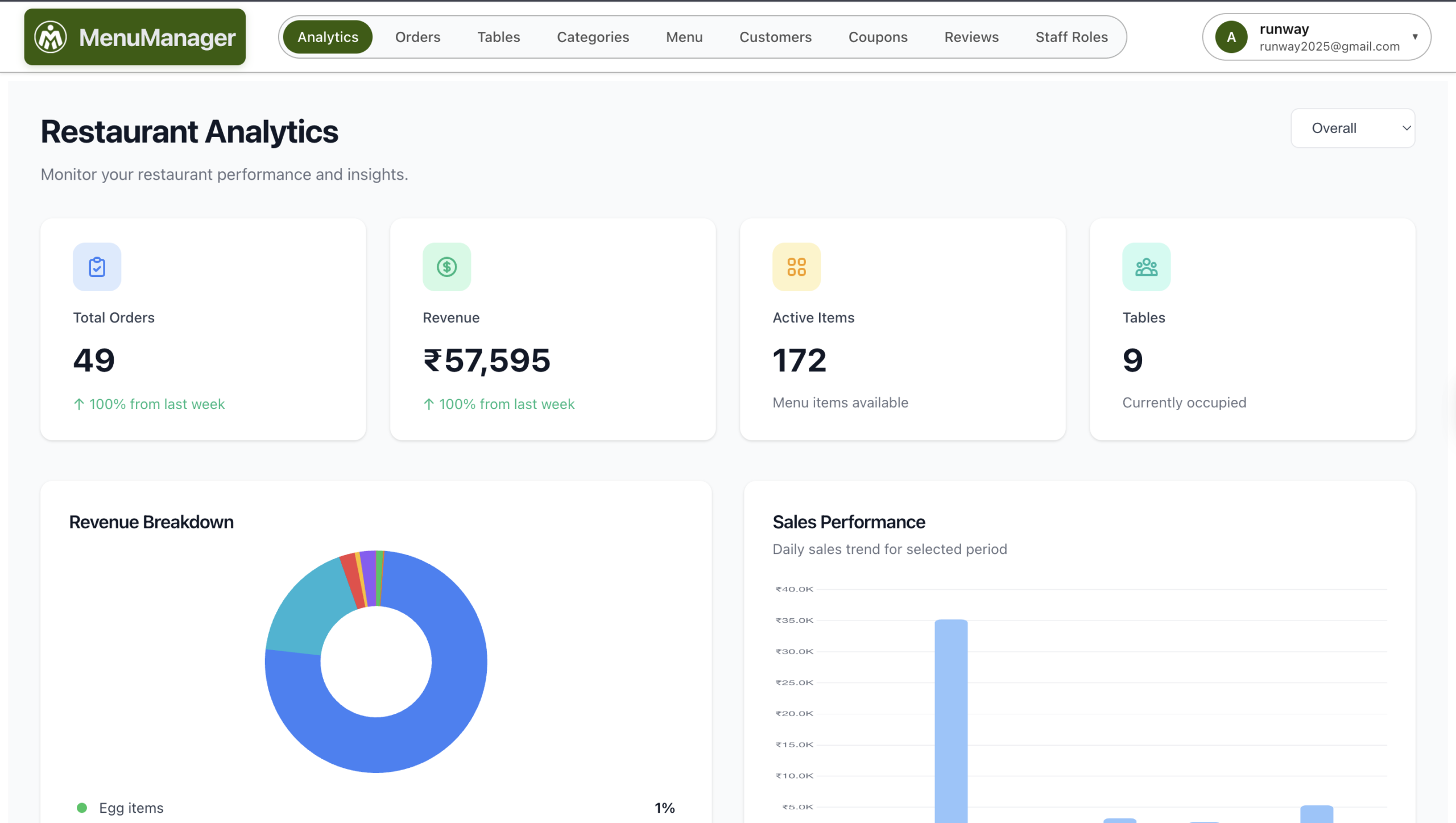
That is exactly what MenuManager helps restaurants do. With a QR-based ordering system that works for both dine-in and takeaway, you can:
- Accept orders directly through your own branded digital menu — zero commission, ever
- Collect customer phone numbers and emails for repeat marketing
- Run your own offers and loyalty programs without platform restrictions
- Reduce dependency on aggregators while maintaining your presence on them
Every customer who walks into your restaurant and scans your QR menu is a customer you can convert to direct ordering forever — no commission paid to anyone.
We wrote a detailed comparison of Zomato vs having your own ordering system — the math is eye-opening for most restaurant owners.
The Ideal 2026 Playbook for Indian Restaurants
- Stay on Zomato & Swiggy — They bring discovery and volume. Negotiate the best commission tier you can.
- Add ONDC via Magicpin — Free to join, low commission. Let it run as a bonus channel.
- Try Rapido Ownly — Zero commission while they are in growth mode (available in select cities).
- Build your own direct ordering with MenuManager — This is your highest-margin channel. Every dine-in customer should leave knowing how to order directly from you next time.
- Gradually shift volume — Use dine-in QR codes, WhatsApp marketing, and Instagram links to push customers toward your own system.
Check out MenuManager pricing — it pays for itself if it saves you even 5 aggregator orders per day in commissions.
Frequently Asked Questions About ONDC Food Delivery
What is the commission rate on ONDC for restaurants?
ONDC commissions typically range from 3-8% of order value, with buyer-side and seller-side apps each charging 2-3%. Some seller network partners like Magicpin currently offer zero-commission onboarding promotions. This is significantly lower than the 18-30% charged by Zomato and Swiggy. However, logistics/delivery costs are separate and paid either by the restaurant or the customer depending on the setup.
How do I register my restaurant on ONDC?
You cannot list directly on ONDC — you need to go through a Seller Network Partner (SNP) like Magicpin, GoFrugal, or Protean. The process involves: (1) choosing an SNP, (2) providing your FSSAI license, GST number, and bank details, (3) uploading your menu with pricing, and (4) waiting for profile approval. Most SNPs charge no upfront fees and the entire process takes 3-7 days.
Is ONDC better than Zomato for restaurants?
It depends on what you mean by “better.” ONDC charges far lower commissions (3-8% vs 20-30%) and gives you more data ownership. However, Zomato delivers dramatically more orders — roughly 20 lakh per day versus ONDC’s 60,000. For most restaurants, ONDC works best as an additional channel alongside Zomato, not a replacement for it. The smartest approach is to use both while building your own direct ordering channel.
How many orders can I expect from ONDC?
This varies widely by city and cuisine. Restaurants in Delhi and Bangalore (where Magicpin has 10%+ market share) report meaningful order volumes. In other cities, volumes remain low. ONDC currently accounts for about 3% of India’s food delivery market. Expect it as a supplementary channel that adds 5-15 extra orders per day in metro cities, rather than a primary revenue driver.
Can I use ONDC and Zomato/Swiggy at the same time?
Absolutely yes. There is no exclusivity requirement. Most restaurants on ONDC continue to operate on Zomato, Swiggy, and other platforms simultaneously. In fact, a multi-channel approach is what we recommend — stay on aggregators for volume, use ONDC for better margins on incremental orders, and build your own direct ordering system for maximum profitability. The key is to not put all your eggs in one platform’s basket.
The Bottom Line
ONDC food delivery is a promising but still maturing channel for Indian restaurants in 2026. The commission savings are real. The government backing is solid. But the order volumes are not yet at a level where it can replace Zomato or Swiggy for most restaurants.
The wisest move? Sign up for ONDC (it is free and low-risk), keep your aggregator presence, and invest seriously in building your own direct ordering channel. That three-pronged approach gives you the reach of aggregators, the margin benefits of ONDC, and the long-term profitability of owning your customer relationship.
Ready to build your own zero-commission ordering system? Try MenuManager free and see how much you could save on every order.

Leave a Reply