


India’s cloud kitchen market crossed ₹3,200 crore in 2025 and is projected to surpass ₹4,000 crore by end of 2026, growing at a blistering 25-28% CAGR. The broader online food delivery market has ballooned to over $55 billion, with cloud kitchens now accounting for 35% of all delivery orders nationwide.
The best part? You do not need ₹20 lakh or a prime high-street location to get started. With the right strategy, a lean cloud kitchen can launch in India for as little as ₹2-5 lakh. If you have been researching how to start cloud kitchen operations on a shoestring budget, this guide walks you through every step — from choosing a business model to getting your first 100 orders per day.
What Is a Cloud Kitchen?
A cloud kitchen (also called a ghost kitchen, dark kitchen, or delivery-only kitchen) is a food preparation facility that operates exclusively for online delivery orders. There is no dine-in area, no waitstaff, and no storefront signage. Orders come in through Zomato, Swiggy, your own website, or WhatsApp — and food goes out through delivery partners.
This model slashes overhead by 40-60% compared to traditional restaurants, making the cloud kitchen India’s fastest path to profitability in the food business.
Types of Cloud Kitchens in India
Before investing a single rupee, decide which model fits your budget, skills, and goals.
1. Single-Brand Cloud Kitchen
One kitchen, one brand, one menu. This is the simplest model and ideal for first-time entrepreneurs. Focus on a niche — biryanis, momos, healthy bowls, or regional thalis — and build a loyal customer base before expanding. Investment: ₹2-5 lakh.
2. Multi-Brand Cloud Kitchen
Run 3-5 virtual brands from a single kitchen, each with its own menu and branding on delivery platforms. One kitchen doing biryani, burgers, and Chinese from the same prep area. Industry data shows multi-brand kitchens generate 3-5x the revenue of single-brand operations from the same space. Investment: ₹5-12 lakh.
3. Shell / Aggregator Kitchen (Shared Model)
Rent a fully-equipped station inside a shared kitchen facility. Companies like Rebel Foods, JEFI Kitchens, and Kitchens Centre provide turnkey infrastructure. You bring the recipe and the brand; they provide the space, equipment, and sometimes even delivery logistics. Investment: ₹1-3 lakh + monthly rent of ₹25,000-50,000.
4. Hub-and-Spoke Model
A central hub kitchen handles bulk prep, while smaller spoke stations near customer clusters handle finishing and dispatch. This works for brands scaling to multiple locations across a city. Investment: ₹10-25 lakh.
How to Start a Cloud Kitchen in India: 10-Step Guide
Step 1: Validate Your Concept with Data
Do not start with your favourite recipe. Start with what your target area is ordering. Open Zomato and Swiggy in your target delivery zone and study:
- Which cuisines have the most orders and reviews?
- What is the average order value (AOV) — aim for ₹250+ per order?
- Which brands have low ratings but high volume (opportunity gaps)?
- What is missing entirely (underserved niches)?
Pro tip: Target a cuisine with at least ₹200 AOV and high repeat-order potential (biryani, North Indian, and Chinese consistently top the charts).
Step 2: Write a Lean Business Plan
Your cloud kitchen business plan does not need to be a 50-page document. Cover these essentials:
- Concept: Cuisine, target customer, unique selling proposition
- Menu: 15-20 items maximum (smaller menus = faster prep, less waste)
- Location: Target delivery radius of 5-7 km
- Budget: Total investment with a 3-month runway
- Revenue target: Orders per day needed to break even
- Channels: Zomato, Swiggy, direct ordering, WhatsApp
Step 3: Choose Your Location Strategically
You do not need a fancy address — you need the right address. The ideal cloud kitchen location has:
- Low rent (basement, industrial area, or back lane of a commercial zone)
- Proximity to high-density residential areas or office clusters
- Easy access for delivery riders (ground floor preferred)
- Proper water supply, drainage, and electrical capacity
- At least 200-300 sq ft of usable kitchen space
Tier-2 cities like Jaipur, Lucknow, Indore, and Coimbatore offer significantly lower rents (₹8,000-15,000/month) while food delivery demand is surging. Do not default to metro cities if your budget is tight.
Step 4: Get Your FSSAI License and Legal Registrations
This is non-negotiable. Zomato and Swiggy will not onboard you without a valid FSSAI number. Here is what you need:
| License / Registration | Cost | Timeline |
|---|---|---|
| FSSAI Basic Registration (turnover up to ₹12 lakh) | ₹100/year | 2-7 days |
| FSSAI State License (turnover ₹12 lakh – ₹20 crore) | ₹2,000-5,000/year | 30-60 days |
| GST Registration | Free | 7-10 days |
| Shop & Establishment License (Municipal) | ₹500-2,000 | 15-30 days |
| Fire Safety NOC (if applicable) | ₹1,000-5,000 | 15-30 days |
| Trade License | ₹1,000-5,000 | 15-30 days |
2026 update: FSSAI now uses geo-tagging and digital monitoring to verify kitchen locations. Kitchens with 10+ rooms must display calorie and allergen information. Apply through foscos.fssai.gov.in.
Documents needed: ID proof, address proof (rental agreement), food safety management plan, passport photos, and PAN card.
Step 5: Set Up Your Kitchen Infrastructure
Equipment is typically your biggest expense (40-55% of startup budget). For a lean single-brand kitchen:
- Cooking range and burners: ₹15,000-40,000
- Refrigerator (commercial): ₹25,000-60,000
- Exhaust and chimney system: ₹15,000-35,000
- Prep tables (stainless steel): ₹8,000-15,000
- Utensils and smallware: ₹10,000-20,000
- Packaging station: ₹5,000-10,000
- Fire extinguisher and safety equipment: ₹2,000-5,000
Budget hack: Buy refurbished commercial equipment from restaurant closures. Check OLX, Indiamart, and local restaurant supply markets — you can save 40-50% over buying new.
Step 6: Design a Delivery-Optimised Menu
Your menu is not a restaurant menu. Every dish must survive 30-45 minutes of transit and still look and taste great. Rules to follow:
- Keep the menu tight: 15-20 items maximum
- Ensure 70%+ of items share common base ingredients (reduces waste and inventory)
- Price for the delivery customer: ₹150-350 is the sweet spot
- Create combo meals (increases AOV by 25-40%)
- Test every dish for packaging durability — soggy food = 1-star ratings
Learn how a smart menu can reduce waste and improve margins in our guide on how to reduce food waste in your restaurant.
Step 7: Get Listed on Delivery Platforms
Register on Zomato and Swiggy as your primary channels. Also consider:
- ONDC: India’s open network for digital commerce — lower commissions (5-8% vs 20-30% on aggregators)
- Direct ordering via your own QR menu: Zero commission, full customer data
- WhatsApp ordering: Build repeat orders from loyal customers
Platform commissions eat 20-30% of your revenue. That is why building a direct ordering channel from Day 1 is critical. More on this in the technology section below.
Step 8: Set Up Your Technology Stack
Technology is not optional for cloud kitchens — it is your storefront, your cashier, and your marketing team. We cover this in detail in the next section.
Step 9: Hire Smart and Start Lean
For a single-brand cloud kitchen, you need:
- 1 head cook: ₹18,000-25,000/month
- 1 helper: ₹10,000-14,000/month
- 1 packaging and dispatch person: ₹10,000-12,000/month
That is a team of 3, costing ₹38,000-51,000/month. You handle operations, marketing, and aggregator management yourself in the first 3-6 months.
Step 10: Launch, Market, and Iterate
Your launch strategy should target 30-50 orders per day within the first month:
- Week 1-2: Offer 50% off on Zomato/Swiggy to generate initial reviews (aim for 50+ ratings quickly)
- Week 3-4: Run targeted Instagram and Google ads for your delivery zone (₹5,000-10,000 budget)
- Ongoing: WhatsApp marketing to every customer, loyalty discounts, and combo deals
- Month 2+: Optimise your menu based on order data — remove low sellers, double down on bestsellers
Cloud Kitchen Cost Breakdown: ₹2-5 Lakh Budget
Here is a realistic cost breakdown for starting a single-brand cloud kitchen in a Tier-1 or Tier-2 Indian city in 2026:
| Expense Category | Tier-2 City | Tier-1 City | Notes |
|---|---|---|---|
| Rent (deposit + 2 months advance) | ₹30,000 – 50,000 | ₹60,000 – 1,20,000 | 200-300 sq ft commercial space |
| Kitchen equipment | ₹80,000 – 1,20,000 | ₹1,00,000 – 1,80,000 | Buy refurbished to save 40% |
| Interior and fit-out | ₹20,000 – 40,000 | ₹30,000 – 60,000 | Basic tiling, plumbing, electrical |
| FSSAI + licenses | ₹3,000 – 8,000 | ₹3,000 – 10,000 | FSSAI, GST, trade license, fire NOC |
| Technology (POS, menu, ordering) | ₹2,000 – 5,000 | ₹2,000 – 5,000 | Monthly SaaS subscription |
| Initial raw materials | ₹15,000 – 25,000 | ₹20,000 – 30,000 | First 2 weeks of inventory |
| Packaging supplies | ₹10,000 – 20,000 | ₹15,000 – 25,000 | Branded containers, bags, cutlery |
| Marketing (launch budget) | ₹15,000 – 30,000 | ₹25,000 – 50,000 | Platform discounts + social media ads |
| Working capital (1 month) | ₹40,000 – 60,000 | ₹60,000 – 1,00,000 | Staff salaries + utilities + supplies |
| Total | ₹2,15,000 – 3,58,000 | ₹3,15,000 – 5,80,000 |
Want to keep costs even lower? Read our detailed breakdown of proven strategies to reduce restaurant operating costs.
Technology Stack for Cloud Kitchens in 2026
In a cloud kitchen, technology is your front-of-house. Without a physical storefront, every customer interaction happens through your digital tools. Here is the tech stack you need:
Essential Technology Checklist
- Digital menu and QR ordering system — Let customers browse your menu and order directly without calling or visiting aggregator apps
- POS (Point of Sale) — Track every order, manage inventory, and generate daily reports
- WhatsApp marketing — Send offers, new menu updates, and re-engage inactive customers automatically
- Order analytics dashboard — Know your top-selling items, peak hours, and per-item profitability
- Aggregator integration — Manage Zomato and Swiggy orders from one screen
- Customer database and CRM — Build a direct relationship with every customer who orders from you
Why Cloud Kitchens Need a Direct Ordering Channel
Here is the maths that every cloud kitchen operator must understand:
- Zomato/Swiggy commission: 20-30% per order
- Direct ordering commission: 0%
- On 100 orders/day at ₹250 AOV, aggregator commissions cost you ₹1.5-2.25 lakh per month
Shifting even 30% of your orders to direct channels saves ₹45,000-67,500 per month — money that goes straight to your bottom line.
MenuManager: Built for Cloud Kitchens
MenuManager is an all-in-one digital ordering platform designed specifically for Indian restaurants and cloud kitchens. Instead of paying for 4-5 separate tools, you get everything in one dashboard:
- QR code ordering: Customers scan, browse your menu, and order directly — zero commissions
- Digital menu management: Update prices, add items, and run offers instantly
- WhatsApp marketing: Automated campaigns to bring customers back
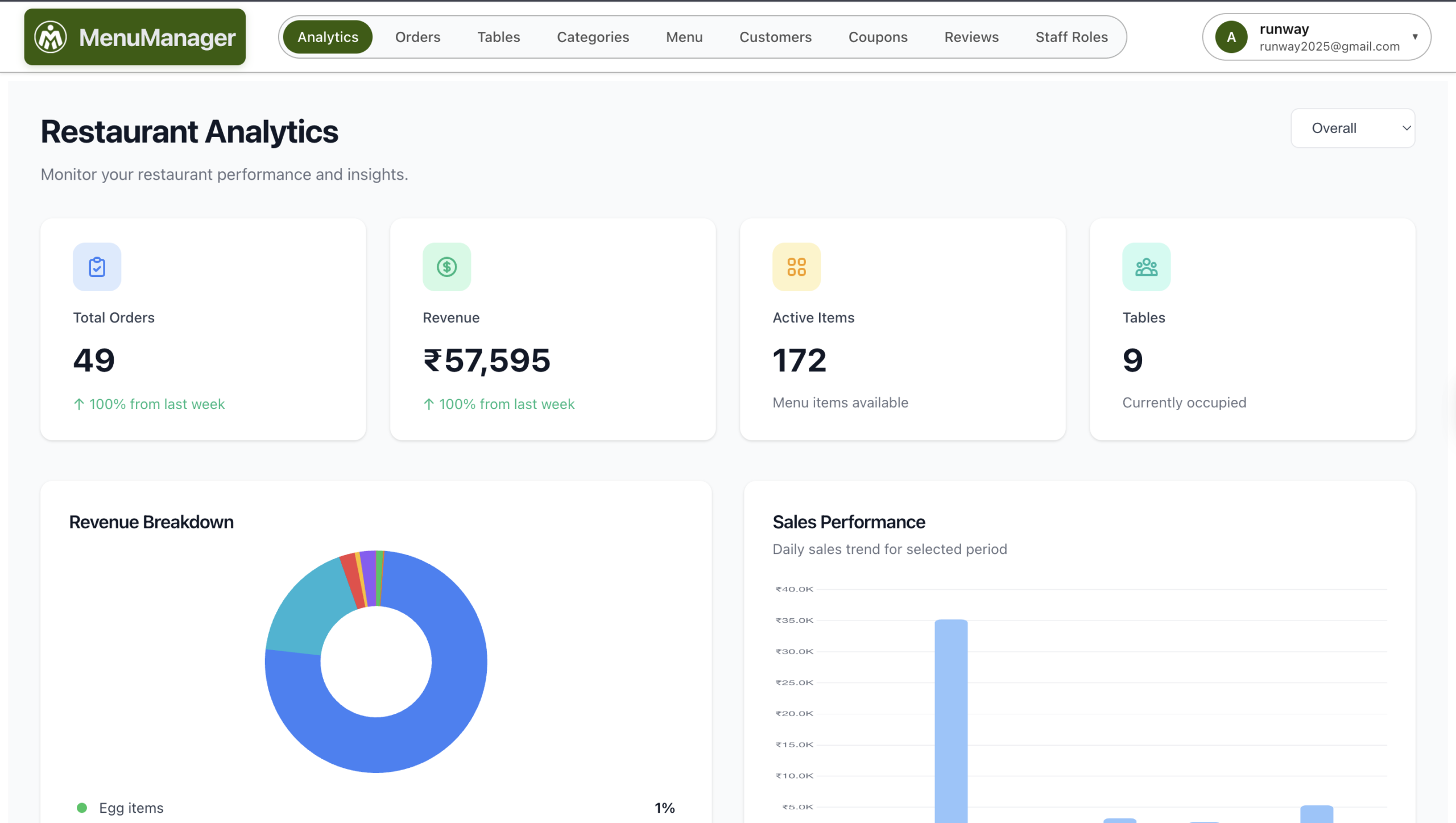
- Order analytics: Track revenue, popular items, and peak hours in real time
- Multi-brand support: Run multiple virtual brands from one account
- Customer data ownership: Build your own customer database instead of renting it from Zomato
For cloud kitchens operating on thin margins, eliminating per-order commissions is the single biggest lever for profitability. Check MenuManager pricing — plans start at a fraction of what you pay in monthly aggregator commissions.
7 Common Mistakes That Kill Cloud Kitchens
- Too many menu items at launch. Start with 12-15 items. A bloated menu increases waste, slows prep time, and confuses customers. Trim ruthlessly based on first-month data.
- Ignoring packaging quality. Your food travels 20-40 minutes before reaching the customer. Invest in leak-proof, insulated packaging. One soggy delivery = one lost customer forever.
- 100% dependence on aggregators. Zomato and Swiggy are powerful discovery tools, but 25-30% commissions will eat your margins alive. Build your direct ordering channel from Day 1.
- Skipping the FSSAI license. Operating without proper licences risks fines up to ₹5 lakh and permanent delisting from delivery platforms. It is not worth the shortcut.
- Choosing the wrong location. A cheap kitchen in a low-demand area is worse than a slightly expensive one near a dense residential zone. Delivery radius and demand density matter more than rent.
- No marketing budget. “Build it and they will come” does not work in food delivery. Allocate at least ₹15,000-30,000/month for the first 3 months on platform promotions and social media.
- Not tracking unit economics. Know your cost per order, per-item food cost, and monthly burn rate. If you are not measuring it, you cannot improve it. Use analytics tools to track every rupee.
Cloud Kitchen Revenue Projections: What to Expect
Here are realistic revenue and profit projections for a single-brand cloud kitchen in India with an average order value of ₹250:
| Metric | Month 1-3 | Month 4-6 | Month 7-12 |
|---|---|---|---|
| Orders per day | 20-35 | 40-60 | 60-100 |
| Monthly revenue | ₹1,50,000 – 2,62,500 | ₹3,00,000 – 4,50,000 | ₹4,50,000 – 7,50,000 |
| Food cost (30-35%) | ₹52,500 – 91,875 | ₹1,05,000 – 1,57,500 | ₹1,57,500 – 2,62,500 |
| Platform commissions (20-25%) | ₹30,000 – 65,625 | ₹60,000 – 1,12,500 | ₹90,000 – 1,87,500 |
| Rent + utilities | ₹20,000 – 35,000 | ₹20,000 – 35,000 | ₹20,000 – 35,000 |
| Staff salaries | ₹38,000 – 50,000 | ₹38,000 – 55,000 | ₹45,000 – 70,000 |
| Packaging (5-8%) | ₹7,500 – 21,000 | ₹15,000 – 36,000 | ₹22,500 – 60,000 |
| Marketing | ₹20,000 – 30,000 | ₹15,000 – 25,000 | ₹10,000 – 20,000 |
| Net profit | -₹18,000 to +₹20,000 | ₹25,000 – 52,500 | ₹52,500 – 1,15,000 |
| Net margin | -12% to +8% | 8% – 12% | 12% – 15% |
Key insight: Most cloud kitchens break even within 6-8 months and achieve 15-25% net margins by the end of Year 1. Kitchens that build a strong direct ordering channel (reducing aggregator commissions) can push net margins to 25-30%.
Want to shift more orders to commission-free channels? MenuManager’s QR ordering system helps cloud kitchens save ₹45,000-67,500 per month by replacing aggregator orders with direct orders.
Frequently Asked Questions
Is a cloud kitchen profitable in India?
Yes. Cloud kitchens in India typically achieve 15-25% net profit margins after stabilisation, compared to 5-12% for traditional restaurants. The lower overhead (no dine-in space, minimal staff, no prime location needed) is the primary advantage. Most operators break even within 6-8 months of launch.
How much does it cost to start a cloud kitchen in India in 2026?
A single-brand cloud kitchen can be launched for ₹2-5 lakh in most Indian cities. This covers rent deposits, basic commercial equipment, FSSAI licensing, initial inventory, packaging, and a small marketing budget. Tier-2 cities are significantly cheaper (starting around ₹2-3.5 lakh) compared to metros (₹3-6 lakh).
Do I need an FSSAI license for a cloud kitchen?
Absolutely. An FSSAI license is mandatory for all food businesses in India, including cloud kitchens. Both Zomato and Swiggy require a valid FSSAI number for onboarding. In 2026, FSSAI has introduced digital geo-tagging to verify kitchen locations. Apply through foscos.fssai.gov.in — basic registration can be approved in as little as 2-3 days.
Can I run a cloud kitchen from home?
Technically yes, but with limitations. Home kitchens must still obtain FSSAI registration, and FSSAI now uses digital monitoring to inspect even home-based kitchens. Your residential society may have restrictions on commercial cooking. The practical approach: start from home to test your concept, then move to a dedicated space once you hit 25-30 orders per day.
How do I reduce aggregator commission costs?
The most effective strategy is to build your own direct ordering channel using a tool like MenuManager. Include a QR code on every delivery package that takes customers to your direct menu. Offer a 10% discount on direct orders (you still save 10-20% compared to paying aggregator commissions). Over 6 months, aim to shift 30-40% of your orders to direct channels. Additionally, explore ONDC-based platforms that charge 5-8% commissions versus the 20-30% charged by Zomato and Swiggy.
Ready to Launch Your Cloud Kitchen?
The cloud kitchen opportunity in India has never been bigger. With over 20,000 cloud kitchens already operating and the market set to double by 2030, the window for early movers — especially in Tier-2 and Tier-3 cities — is wide open.
Start lean, validate fast, and invest in technology that keeps your margins healthy. MenuManager gives you the complete digital toolkit — QR ordering, digital menus, WhatsApp marketing, and real-time analytics — so you can focus on what matters most: great food and happy customers.

Leave a Reply